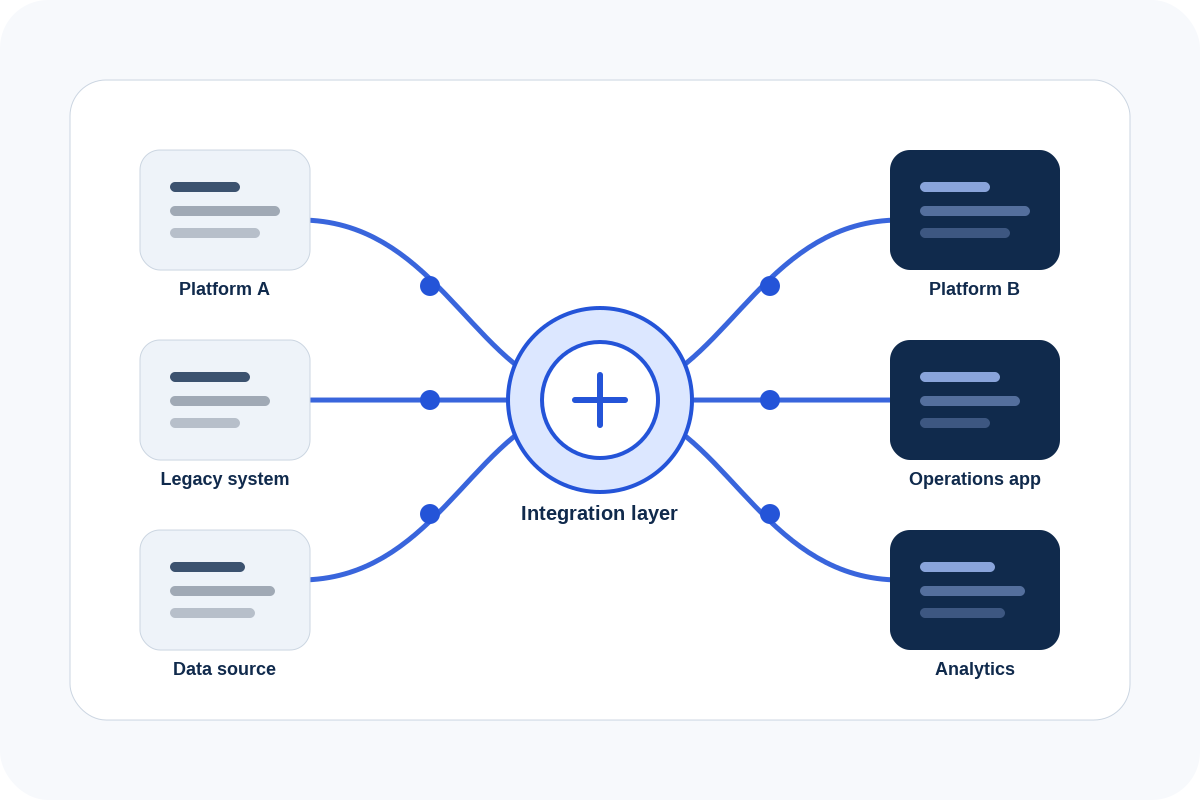
Abstract diagram of multiple platforms connected through an integration layer with mapped data flows.
05
Technical overview
Context, operating intent, and the technical value this service is designed to deliver.
Disconnected platforms create manual work, inconsistent data, and fragile handoffs. We help technical teams design and implement integrations that connect systems, clarify data flows, and align processes—so information moves reliably and operations become more coherent.
We approach integration as an architectural and operational concern: understanding system boundaries, contracts, data ownership, and failure modes before implementation. The result is practical integration designs and workflows that balance reliability, maintainability, and the realities of existing platforms, including legacy systems.
Primary outcome
Reduce fragmentation and improve how information moves across the business.
Problem space
Technical challenges this service addresses.
Common constraints and failure modes we account for when designing and delivering this capability.
!
Fragmented systems with duplicated or inconsistent data across platforms
!
Manual handoffs and swivel-chair processes that slow operations and introduce errors
!
Unclear data ownership, contracts, or flow boundaries between systems
!
Legacy platforms that are difficult to connect with modern services and workflows
!
Limited observability and error handling for cross-system processes
Engagement scope
Boundaries, inputs, and outputs.
A clear view of what is covered, what is needed from your team, and what you can expect to receive.
Included
What we deliver
Discovery of systems, processes, data entities, and integration pain points
Design of integration patterns and data flows suited to technical and operational constraints
Implementation support for agreed integrations across modern and/or legacy platforms
Validation of data movement and workflow behavior for in-scope scenarios
Documentation and handover covering integration behavior and operational touchpoints
Inputs
What we need from you
Access to relevant systems, APIs, documentation, and technical stakeholders
Current process descriptions, data definitions, and known integration issues
Security, access, and compliance constraints for connected systems and data
Priorities for workflows, latency/consistency expectations, and operational ownership
Outputs
Artifacts and outcomes
Documented integration design and data-flow maps for in-scope systems
Implemented integrations/workflows aligned to agreed requirements
Operational notes on failure handling, dependencies, and support considerations
Recommendations for evolving and extending the integration landscape
Delivery model
Phased approach and execution flow.
A structured sequence of activities designed to produce clarity early, reduce risk, and enable sustainable operations.
Phase 01
Discover systems and flows
We map platforms, processes, data entities, and dependencies to understand boundaries, pain points, and where integration will create the most value.
Phase 02
Design contracts and patterns
We define integration patterns, interfaces, and data-flow behavior—including ownership, transformations, and failure considerations—appropriate to each connection.
Phase 03
Implement and connect
We build and configure integrations in manageable increments, validating functional behavior and data movement against agreed scenarios.
Phase 04
Validate, document, and evolve
We verify outcomes, document flows and operational considerations, and identify next steps to improve reliability and extend coverage over time.
Tooling and platforms
Technologies commonly involved.
Tools and platforms we work with in this service area, selected and adapted to your environment and constraints.
AWS
Engineering principles
Practices and controls we emphasize.
Guiding principles that shape how we design, implement, and operate this service for technical teams.
01
Explicit system boundaries, data ownership, and interface contracts
02
Design for failure: clear error handling, retries, and operational visibility where feasible
03
Prefer maintainable, observable integration patterns over brittle point-to-point coupling
04
Security- and access-aware connectivity aligned to organizational constraints
05
Incremental delivery to reduce risk and validate value across complex landscapes
Detailed deliverables
Concrete outputs and artifacts.
Tangible work products, configurations, and documentation produced through this service.
System landscape and dependency mapping for in-scope platforms and processes
Integration architecture and data-flow design (interfaces, contracts, and transformation points)
Implementation of agreed integrations and workflow connections between systems
Error-handling, retry, and operational considerations for reliable cross-system behavior
Documentation of integration flows, dependencies, and support/run considerations
Prioritized roadmap for further integration opportunities and improvements
Technical FAQ
Common questions from engineering teams.
Answers to practical questions about scope, approach, and how this service fits your environment.
Can you integrate with legacy systems or limited APIs?+
Often, yes. We assess available interfaces, constraints, and data access options, then propose practical integration approaches that fit the capabilities and risks of existing systems.
Do you handle real-time and batch integration needs?+
We design integration patterns based on your process and data requirements, including timing, consistency, and reliability considerations, and select approaches that fit your context.
How do you address data consistency and errors between systems?+
We make data ownership and flow behavior explicit, define transformation and validation points, and incorporate appropriate error-handling and operational considerations into the design.
Will the integration be documented for our team to support?+
Yes. We provide documentation of flows, dependencies, and operational touchpoints so your team can understand, support, and evolve the integrations over time.
Fit and context
When this service is most relevant.
Situations and team contexts where this capability typically provides the most value.
Organizations operating multiple platforms with fragmented processes or inconsistent data
Teams needing to connect modern applications with legacy or third-party systems
Technical leads seeking reliable, well-documented cross-system workflows and data flows
Related capabilities
Continue exploring.
Related services that often complement this capability across cloud, delivery, and operations.
01
Cloud Managed Service
Ongoing management and operational care for cloud environments, so your teams can focus on delivering value while infrastructure stays secure, observable, and cost-aware.