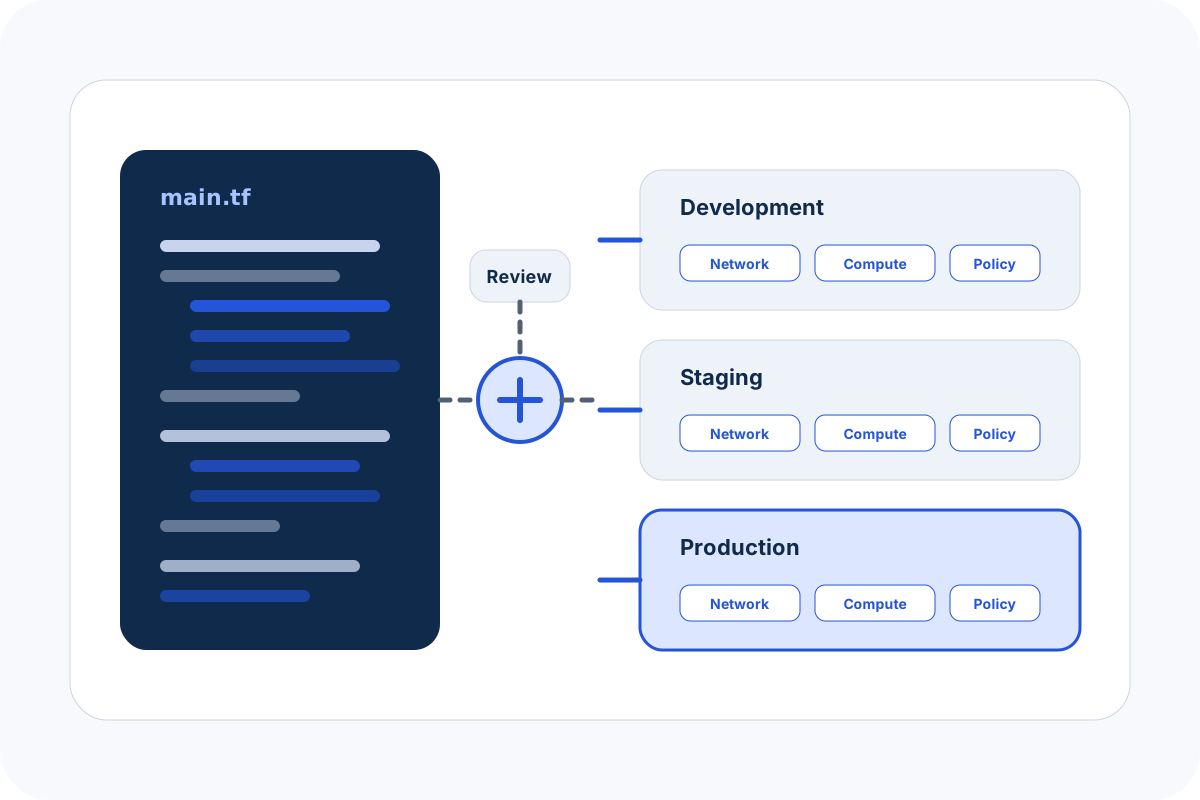
Abstract diagram of infrastructure code reviewed and applied to consistent development, staging, and production environments.
03
Technical overview
Context, operating intent, and the technical value this service is designed to deliver.
Infrastructure defined and managed by hand is difficult to review, reproduce, and evolve safely. We help engineering teams adopt infrastructure as code so environments become declarative, version-controlled, and provisioned through consistent workflows—reducing drift and making change more predictable.
We focus on codifying infrastructure into modular, reviewable definitions with clear state, environment structure, and change workflows. The emphasis is on repeatability, environment parity, controlled provisioning, and maintainable patterns that technical teams can operate and extend over time.
Primary outcome
Reduce drift and configuration risk while scaling environments with confidence.
Problem space
Technical challenges this service addresses.
Common constraints and failure modes we account for when designing and delivering this capability.
!
Manual provisioning and console-driven changes that are hard to audit or reproduce
!
Configuration drift between environments causing inconsistent behavior and release risk
!
Slow or error-prone environment creation for new services, regions, or lifecycle stages
!
Limited review and change control for infrastructure modifications
!
Tightly coupled or duplicated definitions that are difficult to scale and maintain
Engagement scope
Boundaries, inputs, and outputs.
A clear view of what is covered, what is needed from your team, and what you can expect to receive.
Included
What we deliver
Assessment of current infrastructure, provisioning methods, and environment topology
Design of IaC structure, module boundaries, and environment management approach
Implementation of codified resources and workflows for agreed in-scope environments
Establishment of review, plan/apply, and change-control practices for infrastructure
Handover documentation and guidance for ongoing maintenance and extension
Inputs
What we need from you
Access to target cloud accounts, existing infrastructure details, and naming/convention constraints
Current architecture diagrams, resource inventories, or operational knowledge of environments
Requirements for environment separation, networking, security controls, and compliance considerations
Preferred tooling, state management approach, and collaboration workflow (if defined)
Outputs
Artifacts and outcomes
Versioned infrastructure codebase and reusable templates/modules for in-scope components
Documented provisioning and change workflow for engineers to follow
Environment definitions aligned to agreed parity and separation goals
Operational notes covering state, dependencies, and safe iteration practices
Delivery model
Phased approach and execution flow.
A structured sequence of activities designed to produce clarity early, reduce risk, and enable sustainable operations.
Phase 01
Assess topology and risk
We review existing environments, dependencies, and change patterns to identify drift, coupling, and the highest-value areas to codify first.
Phase 02
Design structure and workflows
We define module boundaries, environment layout, state strategy, and review/plan practices to keep infrastructure changes understandable and controlled.
Phase 03
Codify and provision iteratively
We implement declarative definitions and provisioning workflows in manageable increments, validating behavior and parity across targeted environments.
Phase 04
Harden and enable teams
We refine patterns, document operations, and support adoption so teams can manage infrastructure changes safely and evolve the codebase with confidence.
Tooling and platforms
Technologies commonly involved.
Tools and platforms we work with in this service area, selected and adapted to your environment and constraints.
Terraform
AWS
Ansible
Linux
Engineering principles
Practices and controls we emphasize.
Guiding principles that shape how we design, implement, and operate this service for technical teams.
01
Declarative, idempotent definitions with changes driven through version control
02
Environment parity through reusable modules and explicit configuration boundaries
03
Plan-and-review workflows to surface impact before applying infrastructure changes
04
Clear separation of state, secrets, and environment-specific configuration
05
Incremental adoption to reduce risk while improving coverage and consistency
Detailed deliverables
Concrete outputs and artifacts.
Tangible work products, configurations, and documentation produced through this service.
Declarative infrastructure definitions structured for clarity and reuse (modules/templates where appropriate)
Environment provisioning workflows and conventions for consistent application across stages
Version-controlled change process with review and planning practices
State and configuration management guidance to support safe, predictable operations
Documentation of structure, variables, dependencies, and operational procedures
Recommendations for policy, guardrails, and drift-reduction practices aligned to your context
Technical FAQ
Common questions from engineering teams.
Answers to practical questions about scope, approach, and how this service fits your environment.
Do we need to codify everything at once?+
No. We typically prioritize high-value or high-risk components and adopt IaC incrementally, establishing patterns and workflows that can expand safely over time.
How do you manage Terraform state and environment separation?+
We define a state and workspace/environment strategy appropriate to your scale and risk profile, with clear boundaries, access considerations, and documented operating practices.
Can this integrate with our existing CI/CD or review process?+
Yes. Infrastructure changes can be aligned with your existing version control and review workflows, including plan/review steps where they add clarity and control.
What about existing manually created resources?+
We assess existing resources and plan a practical path to bring them under management where appropriate, balancing accuracy, risk, and effort for your environment.
Fit and context
When this service is most relevant.
Situations and team contexts where this capability typically provides the most value.
Teams managing cloud infrastructure manually or struggling with environment drift
Organizations needing repeatable, reviewable provisioning across multiple environments
Technical leads aiming to improve infrastructure governance, auditability, and scalability
Related capabilities
Continue exploring.
Related services that often complement this capability across cloud, delivery, and operations.
01
Cloud Managed Service
Ongoing management and operational care for cloud environments, so your teams can focus on delivering value while infrastructure stays secure, observable, and cost-aware.
Managing Code Repositories and Artifact Management
Structured repository practices and artifact management that give teams clear ownership, traceable history, and dependable access to the builds they ship.