Managing Code Repositories and Artifact Management
Structured repository practices and artifact management that give teams clear ownership, traceable history, and dependable access to the builds they ship.
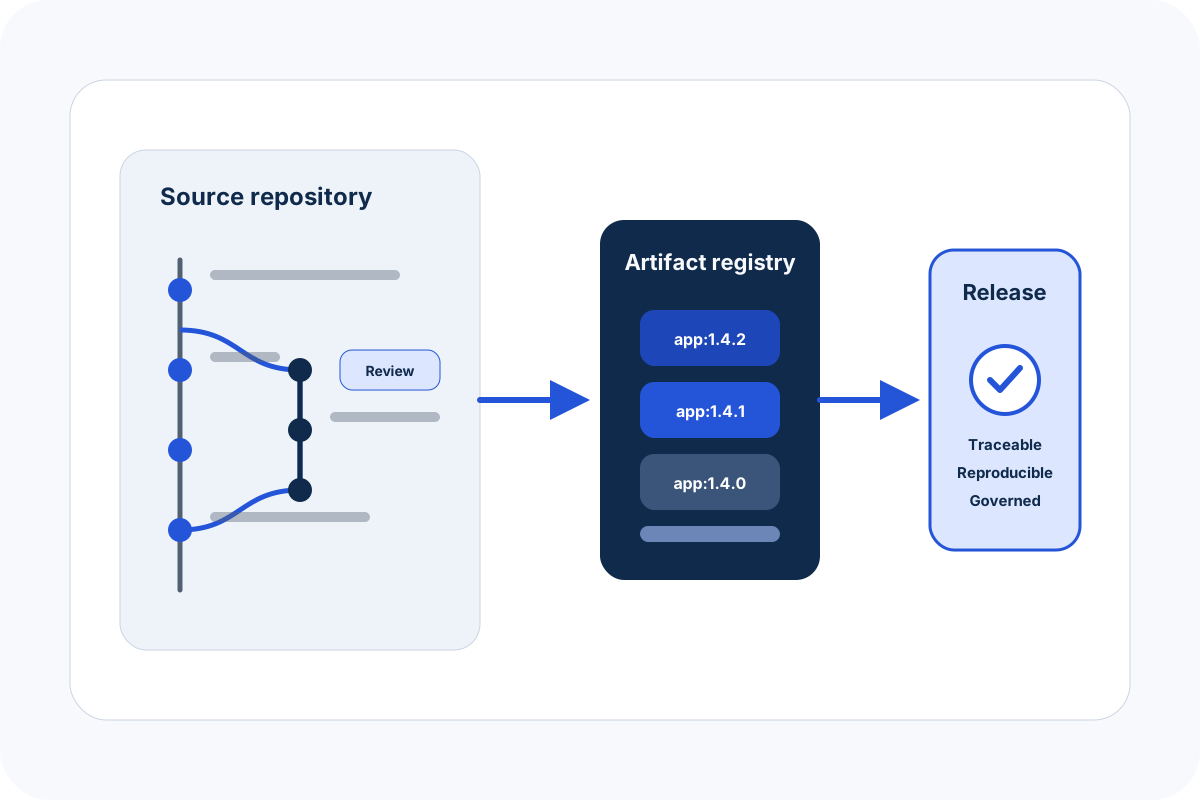
Abstract diagram of source branches, reviews, a versioned artifact registry, and governed releases.
04
Technical overview
Context, operating intent, and the technical value this service is designed to deliver.
Delivery confidence depends on being able to answer where code lives, how it changed, and exactly which artifact was released. We help teams establish repository and artifact management practices that improve ownership, traceability, and reproducibility across the software supply path.
We align source control structure, contribution workflows, access boundaries, and artifact handling into a coherent, auditable model. The focus is on governance and traceability—linking commits, builds, versions, and releases so engineers can operate with clarity and control.
Primary outcome
Strengthen code governance and make every release traceable and reproducible.
Problem space
Technical challenges this service addresses.
Common constraints and failure modes we account for when designing and delivering this capability.
!
Inconsistent repository structures and naming that make ownership and navigation unclear
!
Ad hoc branching and review practices leading to fragile or opaque release histories
!
Unclear access controls or permissions that increase governance and security risk
!
Build artifacts stored informally, making releases hard to trace, reproduce, or roll back
!
Weak versioning and dependency policies causing ambiguity across services and environments
Engagement scope
Boundaries, inputs, and outputs.
A clear view of what is covered, what is needed from your team, and what you can expect to receive.
Included
What we deliver
Assessment of current repositories, workflows, permissions, and artifact handling practices
Definition of governance standards for source control, reviews, and artifact lifecycle
Implementation guidance or setup support for agreed repository/artifact structures
Documentation of workflows, policies, and operational responsibilities
Enablement to help teams adopt and sustain consistent practices
Inputs
What we need from you
Access to relevant source control platforms, repositories, and artifact storage systems
Current team structure, ownership model, and collaboration/release workflows
Requirements for compliance, auditability, retention, and access boundaries
Inventory of services, build outputs, and dependency management practices (where available)
Outputs
Artifacts and outcomes
Documented repository and artifact governance standards for in-scope teams/projects
Defined branching/review and versioning workflows with clear roles and expectations
Practical artifact organization and traceability model for releases
Actionable recommendations to improve consistency, access clarity, and provenance
Delivery model
Phased approach and execution flow.
A structured sequence of activities designed to produce clarity early, reduce risk, and enable sustainable operations.
Phase 01
Assess current state and gaps
We review repository layouts, workflows, permissions, and artifact flows to identify governance gaps, traceability breaks, and operational friction.
Phase 02
Define standards and policies
We establish practical conventions for structure, branching, reviews, access control, versioning, and artifact lifecycle suited to your teams.
Phase 03
Implement structure and workflows
We help apply the agreed model across repositories and artifact stores, aligning tooling configuration and day-to-day processes with the standards.
Phase 04
Enable adoption and traceability
We document practices, support team adoption, and refine the model so source-to-release traceability remains clear and maintainable over time.
Tooling and platforms
Technologies commonly involved.
Tools and platforms we work with in this service area, selected and adapted to your environment and constraints.
GitHub
GitLab
GitHub Actions
Engineering principles
Practices and controls we emphasize.
Guiding principles that shape how we design, implement, and operate this service for technical teams.
01
Clear ownership and access boundaries aligned to team responsibilities
02
Versioned, immutable build artifacts with explicit provenance from source to release
03
Reviewable change history through consistent branching and merge practices
04
Policy-driven dependency and version management to reduce ambiguity and risk
05
Documentation and conventions that make governance usable, not burdensome
Detailed deliverables
Concrete outputs and artifacts.
Tangible work products, configurations, and documentation produced through this service.
Repository organization and contribution standards (structure, naming, documentation expectations)
Branching, review, and merge workflow definitions aligned to your delivery model
Access-control and permission model recommendations for teams and repositories
Artifact repository usage patterns and versioning conventions for build outputs
Traceability practices linking source revisions, builds, artifacts, and deployments
Policy guidance for dependencies, retention considerations, and release provenance
Technical FAQ
Common questions from engineering teams.
Answers to practical questions about scope, approach, and how this service fits your environment.
Can you work with our existing Git platform and tooling?+
Yes. We align standards and workflows with the platforms you already use, focusing on practical governance and traceability improvements within your current environment.
How do you improve traceability from source to release?+
We define conventions that link commits, builds, artifact versions, and deployments—supported by repository structure, tagging/versioning practices, and documented release workflows.
Will this slow down developer workflows?+
The intent is the opposite: clear, lightweight standards reduce confusion and rework. We tailor practices to your team size and delivery needs to keep workflows efficient and consistent.
Do you cover dependency and versioning policies?+
Yes. We provide guidance on versioning conventions and dependency handling appropriate to your projects, helping teams manage change and compatibility with greater clarity.
Fit and context
When this service is most relevant.
Situations and team contexts where this capability typically provides the most value.
Teams with growing codebases, multiple repositories, or unclear ownership and workflows
Organizations needing stronger traceability, auditability, and release reproducibility
Technical leads standardizing contribution, access, and artifact practices across teams
Related capabilities
Continue exploring.
Related services that often complement this capability across cloud, delivery, and operations.
01
Cloud Managed Service
Ongoing management and operational care for cloud environments, so your teams can focus on delivering value while infrastructure stays secure, observable, and cost-aware.