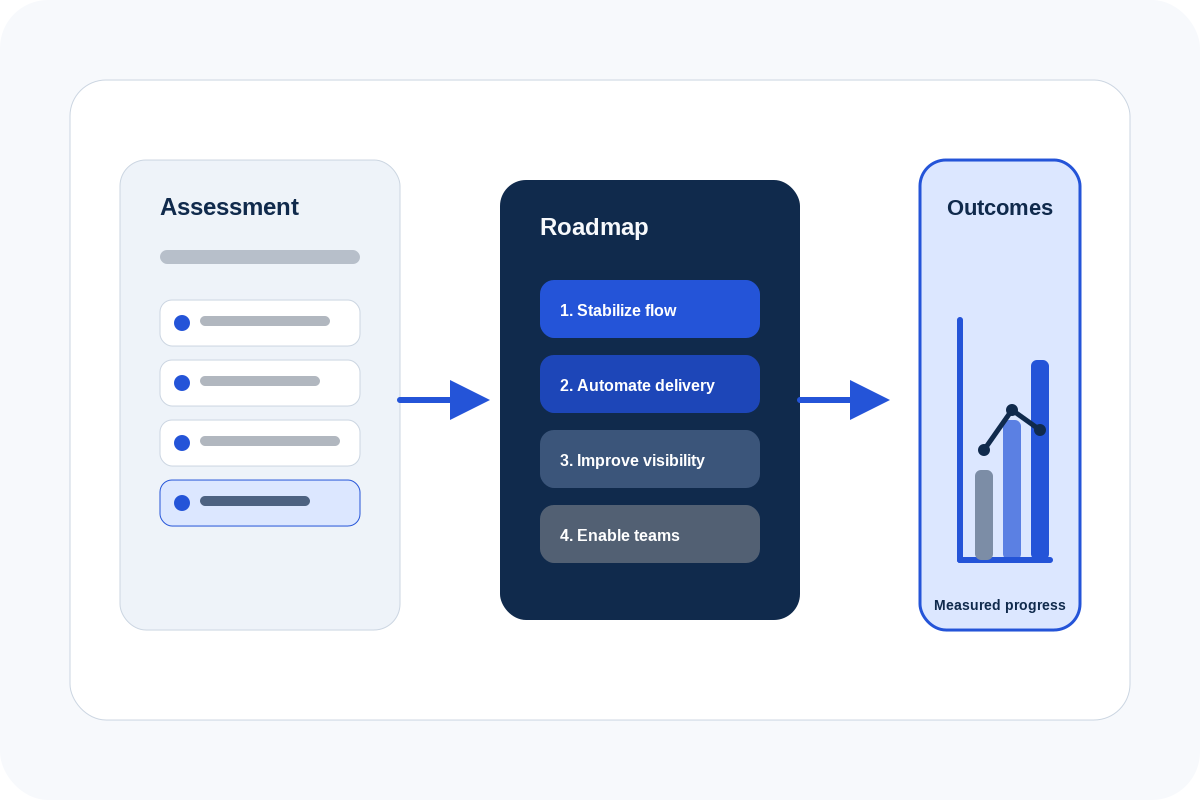
Abstract diagram of DevOps assessment, roadmap planning, and measurable improvement outcomes.
06
Technical overview
Context, operating intent, and the technical value this service is designed to deliver.
Improving delivery performance requires more than new tools—it requires a clear understanding of flow, constraints, and operating practices. We provide technical DevOps consulting that helps engineering teams assess their current state, prioritize high-impact changes, and adopt practices that make delivery faster, safer, and more sustainable.
We work with technical leads to examine the end-to-end delivery system: source control, CI/CD, infrastructure management, environments, release practices, and feedback loops. Recommendations are grounded in your constraints and capacity, producing a practical roadmap with actionable engineering and process improvements.
Primary outcome
Build a realistic, measurable path toward faster and safer delivery.
Problem space
Technical challenges this service addresses.
Common constraints and failure modes we account for when designing and delivering this capability.
!
Unclear bottlenecks across build, test, release, and operational workflows
!
Tooling sprawl or misaligned platforms that add complexity without improving flow
!
Inconsistent practices across teams leading to variable delivery quality and speed
!
Limited visibility into delivery performance, reliability, and improvement progress
A clear view of what is covered, what is needed from your team, and what you can expect to receive.
Included
What we deliver
Discovery with engineering stakeholders on workflows, tooling, architecture, and pain points
Assessment of delivery pipeline, infrastructure practices, and operational routines
Prioritization of improvements based on impact, effort, and organizational capacity
Advisory support and recommendations for implementing selected initiatives
Documentation of findings, roadmap, and practical guidance for sustained progress
Inputs
What we need from you
Access to relevant stakeholders, repositories, pipelines, and infrastructure context
Current documentation of processes, environments, and tooling (where available)
Visibility into recent delivery challenges, incidents, or operational pain points
Business and engineering goals, constraints, and capacity for change
Outputs
Artifacts and outcomes
Assessment summary highlighting strengths, gaps, and key constraints
Actionable DevOps roadmap with prioritized initiatives and rationale
Tooling/workflow recommendations and implementation guidance for in-scope areas
Suggested measures and review cadence to evaluate ongoing improvement
Delivery model
Phased approach and execution flow.
A structured sequence of activities designed to produce clarity early, reduce risk, and enable sustainable operations.
Phase 01
Discover and assess
We engage stakeholders and review delivery workflows, tooling, and operating practices to understand how work flows today and where friction or risk accumulates.
Phase 02
Identify constraints and priorities
We analyze findings to surface systemic bottlenecks and opportunities, then prioritize changes that are feasible within current capacity and aligned to goals.
Phase 03
Define roadmap and recommendations
We produce a practical roadmap covering process, tooling, and technical practices—such as CI/CD, IaC, and environment management—tailored to your context.
Phase 04
Enable, measure, and iterate
We support teams with guidance and enablement, recommend meaningful indicators of progress, and help establish a cadence for reviewing and adapting improvements.
Tooling and platforms
Technologies commonly involved.
Tools and platforms we work with in this service area, selected and adapted to your environment and constraints.
AWS
Linux
Terraform
Docker
Kubernetes
GitHub
GitHub Actions
GitLab
Argo CD
Grafana
Prometheus
OpenTelemetry
Engineering principles
Practices and controls we emphasize.
Guiding principles that shape how we design, implement, and operate this service for technical teams.
01
Improve flow by addressing systemic constraints, not isolated symptoms
02
Favor pragmatic, incremental changes that fit team capacity and operating reality
03
Treat delivery systems (pipelines, infrastructure, environments) as engineered products
04
Make work visible with useful metrics and feedback loops, avoiding vanity measures
05
Enable teams through shared understanding, documentation, and sustainable practices
Detailed deliverables
Concrete outputs and artifacts.
Tangible work products, configurations, and documentation produced through this service.
Current-state delivery and operations assessment with identified constraints and opportunities
Prioritized improvement roadmap with practical, sequenced initiatives
Tooling and platform recommendations aligned to workflows, skills, and constraints
Guidance on CI/CD, infrastructure practices, environment management, and collaboration patterns
Suggested metrics and feedback mechanisms to track delivery and operational improvement
Enablement sessions and actionable next steps for engineering teams and leads
Technical FAQ
Common questions from engineering teams.
Answers to practical questions about scope, approach, and how this service fits your environment.
Is this advisory-only or do you help with implementation?+
We provide assessment and hands-on guidance tailored to your needs. Engagement can focus on roadmap and enablement, and can also include support for implementing selected technical improvements.
How do you measure improvement without relying on vanity metrics?+
We recommend indicators that reflect real delivery and operational outcomes in your context, paired with a review cadence so progress is visible, interpretable, and actionable.
Can you work with our current tools and processes?+
Yes. We start from your existing environment and constraints, then recommend changes that are practical and compatible—evolving what you have rather than forcing unnecessary replacements.
How do you avoid disrupting ongoing delivery work?+
We prioritize incremental, high-impact initiatives and sequence them around team capacity, so improvements can be adopted alongside ongoing commitments with manageable risk.
Fit and context
When this service is most relevant.
Situations and team contexts where this capability typically provides the most value.
Technical leads seeking a clear, evidence-informed path to improve delivery performance
Teams balancing platform and process improvements with ongoing product delivery
Organizations wanting to align tooling, practices, and culture around reliable delivery
Related capabilities
Continue exploring.
Related services that often complement this capability across cloud, delivery, and operations.
01
Cloud Managed Service
Ongoing management and operational care for cloud environments, so your teams can focus on delivering value while infrastructure stays secure, observable, and cost-aware.